The Cosmic Muon Tracker
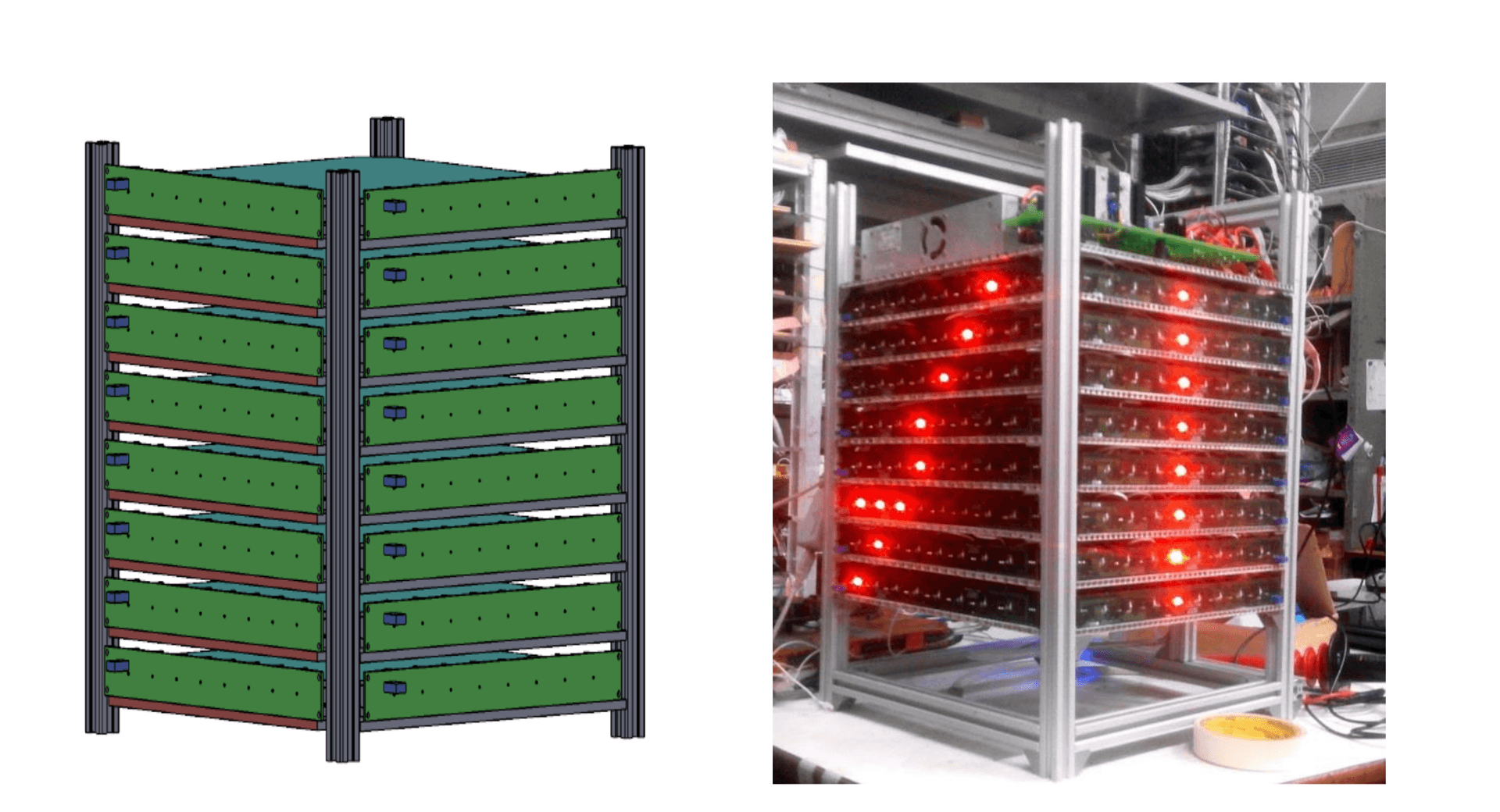
The Cosmic Muon Tracker (CMT) is a portable charged-particle tracker that detects and records live muon trajectories. Eight layers of Resistive Plate Chambers (RPCs) track muons by ionisation as they pass through the detector. Each event is processed by an FPGA-based data acquisition system that generates event records based on coincidence logic, and LED arrays display events in real time.
The CMT was built as part of the research programme for the India-based Neutrino Observatory (INO). It can plot the angular distribution of muons, measure counting rates of individual strips, and record the dependence of these rates on ambient parameters — temperature, relative humidity, and barometric pressure — via the DAQ module.
Muons
The muon is an elementary particle in the lepton family (second generation), one of nature's fundamental building blocks of matter. Muons were discovered by Carl D. Anderson and Seth Neddermeyer at Caltech in 1936 while studying cosmic radiation, and confirmed in 1937 by Street and Stevenson's cloud chamber experiment.
Muons are spin-½ particles, similar to electrons with electric charge −1e but roughly 207 times heavier, with a mass of 105.7 MeV/c². They participate in electromagnetic and weak interactions but not in the strong force. Due to their mass, muons are unstable and decay via the weak force, either by nuclear capture (emitting a neutron) or by spontaneous decay into an electron (or positron) and two neutrinos.
The muon population decays exponentially with time: N(t) = N(0) · exp(−t/τ), where τ = 2.197 μs is the muon lifetime.
N(t) = N(0) · exp(−t / τ), τ = 2.197 μsSource of Cosmic Muons
Earth's upper atmosphere is continuously bombarded by primary cosmic radiation — mainly protons and heavier nuclei (helium, carbon, oxygen, ~98%) and electrons (~2%). The primary source of these cosmic rays is supernovae.
Primary cosmic rays collide with atmospheric nuclei and produce cascades of secondary particles including neutral and charged pions. Most of these secondary particles are short-lived and do not survive to reach ground level. However, positive and negative pions decay into highly energetic muons, which travel close to the speed of light. Time dilation allows them to survive long enough to be detected at ground level despite their short lifetime.
Resistive Plate Chambers
The Resistive Plate Chamber (RPC) is a gaseous charged-particle detector. It uses a constant, uniform electric field produced by two parallel electrode plates made of high bulk-resistivity material. The RPC was introduced in 1981 by R. Santonico and R. Cardarelli as a practical alternative to spark counters.
Charged particles traversing the active area ionise a gas mixture (R134a, isobutane C₄H₁₀, and SF₆) flowing between the electrodes. The resulting electron avalanche under the strong uniform field induces a signal on external readout strips. The glass electrodes used in this experiment are coated with graphite on the outer side to apply the high voltage uniformly.
Glass RPCs have been proposed as the active detector element for the Iron Calorimeter (ICAL) in the India-based Neutrino Observatory (INO), and are used in RPCs-based tracking and trigger systems in most major high-energy physics experiments currently operational. The CMT uses them for both triggering and tracking of charged particles.
Master's Thesis
The thesis work at TIFR's Department of High Energy Physics covered the full fabrication and characterisation pipeline for glass RPCs: gas gap assembly, electrode preparation, graphite coating, gas system plumbing, and high-voltage conditioning.
Characterisation measurements included efficiency versus high-voltage curves, cluster size distributions, and the dependence of detection efficiency on gas mixture composition and flow rate. The results were compared against the INO ICAL design specifications.